Capacity first
Which saws fit the cut envelope?
Filter documented woodworking models by required cutting height and throat. A dimensional match is a shortlist, not proof of performance or safe use.
The small-shop buying desk
Choose a benchtop band saw by the cuts you need to make. Start with stock height and inward reach, then verify the exact blade loop, supported materials and complete workshop setup.
You do not need to read every guide first. Pick the question that is limiting your decision, then return here to compare the complete system.
Capacity first
Filter documented woodworking models by required cutting height and throat. A dimensional match is a shortlist, not proof of performance or safe use.
Blade first
Look up exact-model loop length and permitted width range before comparing teeth, material or marketplace listings.
Model first
Compare documented capacity, blade systems and regional caveats side by side without merging nearby model generations.
Shortlist first
Use the separate buying guide for editorial selection criteria and tradeoffs after this homepage helps define your requirements.
These models provide useful starting points for comparing compact capacity and setup. Read the exact-model guide before deciding; an Amazon listing is an offer to inspect, not a performance test.
As an Amazon Associate I earn from qualifying purchases. How affiliate links work.

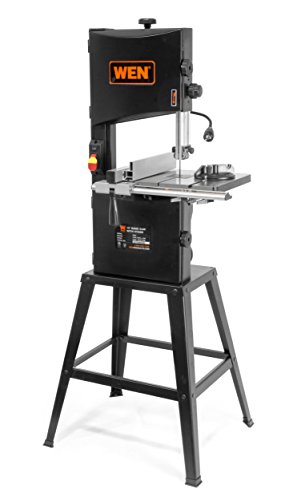

saw
wood · 70.5 in blade
Check Amazon offerA 9-inch or 10-inch label usually describes a size class associated with the wheels and throat. It does not mean the saw cuts stock that thick. Cutting height, blade length and the practical working envelope deserve separate checks. Two similarly sized machines can require different replacement blades, and two versions of one model family may differ in controls or package contents.
For small curved parts, start with the minimum approved blade width and the room available around the cut. For resawing, start with the height of the board standing on edge, the permitted blade system and the manufacturer’s intended duty. A published maximum clearance is not a promise that the saw will comfortably resaw every species at that thickness.
| Model | Machine family | Cut height (in) | Throat (in) | Blade length (in) | Blade width range (in) | Offer |
|---|---|---|---|---|---|---|
| WEN BA3959 | Compact woodworking | 3.5 | 9 | 59.5 | 0.125–0.375 | Check Amazon offer |
| WEN BA3962 | Compact woodworking | 6 | 9.75 | 72 | 0.125–0.5 | Check Amazon offer |
| RIKON 10-3062S | Compact woodworking | 5 | 9.625 | 70.5 | 0.125–0.5 | Check Amazon offer |
Our capacity finder filters documented woodworking models. The blade-size finder keeps exact machine identity in view so that a 59½-inch blade does not become an assumed substitute for a 62-inch loop.
Match blade width, table support and the turning room your shapes need.
Plan stock height, blade kerf and surfacing allowance before buying for capacity.
Compare dedicated low-speed metal machines and distinguish them from wood saws.
Woodworking bandsaws and compact metal-cutting machines should not be treated as interchangeable simply because both use a continuous blade. Speed, tooth design, workholding and manufacturer-approved materials determine the appropriate machine family. A two-speed woodworking saw is not automatically a steel-cutting saw.
The newer compact machines
New compact models such as the Laguna V:10 make current documentation especially important. Listings and revised manuals may describe different capacities. Our model guides keep those differences visible instead of silently merging every specification into one record.
Bring the exact model number, regional voltage and manual revision into the comparison. The same discipline matters for legacy RIKON, SKIL and WEN machines bought used.
Read the Laguna V:10 guide
Look up blade dimensions, compare two machines, estimate finished-board yield and total the cost of a usable setup. Calculators show their assumptions and leave operational judgments to the exact manuals and your workshop conditions.
Filter documented woodworking bandsaws by cutting height and throat capacity, with exact-model guides and relevant Amazon offers.
Look up exact-model blade length, width and documented thickness records, then choose TPI and tooth form for the material without assuming listing compatibility.
Estimate how many finished boards fit within stock thickness after blade kerf and surfacing allowance. Plan material before choosing a saw.
Add the saw, blades, stand, dust connections and workshop extras to compare complete setup budgets using your own current quotes.
Estimate a rectangular work zone using your machine footprint and chosen clearances. Plan space without confusing table dimensions with base size.
Put two documented bandsaw models side by side. Check blade systems, cutting capacity and regional caveats alongside matched product offers.
A bandsaw earns its place when its strengths match the work. It can be useful for curved outlines and dividing thicker stock, while a scroll saw, table saw or jigsaw may be a better fit for a different task. Start with the decision you are trying to make, then compare exact models within the right machine family.
comparisons
Choose between a benchtop bandsaw and scroll saw by interior cuts, fine detail, stock thickness, resawing needs, and the scale of your projects.
comparisons
Compare bandsaws and table saws for curves, repeated ripping, sheet goods, resawing, surface finish, and the space each working station requires.
comparisons
Compare a bandsaw and jigsaw for curved cuts, interior openings, large sheets, thick stock, portability, and the support each cutting method needs.
comparisons
Compare wood and metal bandsaws by blade speed, workholding, tooth selection, machine layout, and the limits of changing blades or pulley settings.
comparisons
Compare metal bandsaws and chop saws for bar, tube, repeated lengths, workholding, consumables, and why woodworking saws are a separate choice.
comparisons
Compare benchtop and floor bandsaws by regular workload, working space, stock support, installation, and the point where a larger machine makes sense.
comparisons
Compare 9-inch and 10-inch bandsaws by actual cutting height, throat, blades, station size, and the projects that justify a larger compact machine.
comparisons
Compare WEN and RIKON compact bandsaws by capacity, adjustment convenience, model generation, complete station cost, and the work you intend to make.
comparisons
Compare WEN BA3959 and SKIL BW9501 benchtop bandsaws by blade system, speed choices, setup access, total cost, and realistic small-project needs.
Plan the blade, support surface, dust connection and stock travel together. A low machine price can lose its advantage once you add a stable stand, the blade needed for your projects and the parts required to connect an existing extractor. Conversely, a larger kit can duplicate equipment you already own.
Check replacement blade supply early. Length, width and thickness must fit the saw; tooth pitch and construction must fit the material and cut. Guide bearings, tires and fences also need exact fit checks. Our accessory guides explain the measurements to compare without treating a broad marketplace compatibility claim as proof.
Compare documented bandsaw capacities, blade systems and regional variants. Find exact-model guidance before choosing a compact saw or a larger upgrade.
Understand which differences matter between bandsaws, competing models and other saw types. Compare cutting capacity, setup and intended projects.
Choose a bandsaw around budget, material, workshop size and cutting needs. Explore clear buying criteria and the limits of compact machines.
Understand current and legacy bandsaw families. Compare model generations, parts support, regional specifications and realistic buying choices.
Find practical answers about benchtop bandsaw uses, materials, cutting techniques, troubleshooting and care, grounded in manufacturer documentation.
Choose blade lengths, widths, tooth patterns, guides and workshop accessories. Check the exact machine requirements before buying replacements.
Clear answers to the supplied search questions and relevant questions observed in Google results, with links to more detailed guides. Related phrasings share the same guide when they describe the same buying decision.
The best choice depends on your material, cutting height, blade requirements and workshop space. Compare exact models and the cost of a complete setup rather than choosing by nominal wheel size alone.
Read the detailed guideThe term bench saw can refer to a table saw, not necessarily a bandsaw. A benchtop bandsaw uses a continuous loop blade for work such as curved outlines and ripping within its documented capacity; a table saw serves a different set of cutting tasks.
Read the detailed guideValue depends on the work the machine can actually handle and the additional blades, support and dust equipment it needs. A budget saw can make sense for smaller projects, but insufficient cutting height or poor parts availability can erase the initial saving.
Read the detailed guideA different saw may better suit a particular cut. A scroll saw suits intricate internal cutouts, a table saw suits many straight sizing tasks, and a jigsaw brings the tool to larger work. None replaces every bandsaw function.
Read the detailed guideAssess the exact machine and task. The Bauer benchtop woodworking saw, Hercules portable metal saws and older Central Machinery machines are different products. Check documented capacities, controls and support against your intended work.
Read the detailed guideSome manufacturers offer US-made industrial bandsaws, but that does not establish US manufacture for a compact machine sold under an American brand. Verify the exact model and current origin statement; company headquarters alone is insufficient.
Read the detailed guideChoose within the correct machine family first, then compare actual cutting height, throat, blade system and setup requirements. Our shortlist explains the tradeoffs instead of claiming one saw wins every task.
Read the detailed guideIt is a tooth-engagement guideline often used in blade selection, especially for metal cutting. It is not a universal setting for every material, tooth design or workpiece. Follow the blade maker’s chart and machine instructions for your exact section and cut.
Read the detailed guideThere is no single best blade for every saw and project. Length and permitted width must fit the machine; tooth pattern, pitch and construction must suit the material and cut. A compromise blade may sacrifice curve radius or resaw efficiency.
Read the detailed guideThat wording can describe different classifications. Regular, skip and hook are common tooth patterns; carbon steel, bimetal and carbide describe construction categories. Identify which classification a recommendation means before choosing.
Read the detailed guideThe loop length is fixed by the exact saw, while useful width depends on the intended cut. Narrow blades can suit tighter curves; wider approved blades can support straighter cuts. Check thickness and tooth requirements as well.
Read the detailed guideA skip-tooth pattern provides more space between teeth for chip clearance in appropriate materials and applications. Choose it using the blade manufacturer’s recommendations; it is not automatically the right pattern for every wood or metal cut.
Read the detailed guidePitch depends on material, stock thickness, blade design and the saw. Coarser recommended patterns can help clear the larger volume of chips from thick wood, but there is no universal TPI that is best for every resawing job.
Read the detailed guideCompare the height of the board on edge, documented cutting capacity, approved blade system and intended workload. A small saw that admits the stock is not necessarily suitable for frequent full-height resawing.
Read the detailed guideThe board dimension standing vertically must fit the cutting height, while its path must fit the throat and support arrangement. Nominal 9-inch or 10-inch saw size does not state the available resaw height.
Read the detailed guideUse the correct loop length and an approved width and thickness for your machine. Evaluate the blade maker’s wood, thickness and tooth recommendations; the widest blade a saw accepts is not automatically the best practical choice.
Read the detailed guideResawing is a cutting task that divides stock into thinner pieces. A general-purpose bandsaw may perform it within its capacity, while a dedicated resaw is designed around that task and workload.
Read the detailed guideStart with the material, workpiece section, angled-cut requirements and workholding. Compare dedicated compact metal machines separately from portable saws used with an approved stand. Woodworking saws are not substitutes merely because they have two speeds.
Read the detailed guideUse a blade manufacturer’s selection chart for the alloy and effective material thickness, including tubing wall engagement. Machine speed and blade construction also matter. A single TPI recommendation cannot cover every solid bar and thin-wall tube.
Read the detailed guideCompare cutting capacity, speed range, power source and handling for the actual work. If mounting it to a stand, verify that exact saw-and-stand combination separately; a handheld capacity claim does not establish mounted capacity.
Read the detailed guideA good fit offers enough documented capacity for your projects, an available replacement blade system and a stable support arrangement. Distinguish woodworking tabletop saws from low-speed metal-cutting machines before comparing features.
Read the detailed guide“Largest” can mean wheel size, cutting height or overall footprint. Compare those measurements separately and distinguish a machine designed for a bench from a floor saw that merely looks compact.
Read the detailed guideWEN sells different benchtop model families. BA3959, 3939T, 3962T and BA3962 should be reviewed by exact model number because blade lengths and package details differ. Our WEN guide compares those identities using documentation.
Read the detailed guideThey can be worthwhile for recurring curved cuts, small projects and appropriate occasional resawing. Their value depends on the work, total setup cost and limitations; a different saw may suit your projects better.
Read the detailed guideUse a bandsaw for supported curved outlines, ripping and resawing when the exact machine, blade and stock dimensions fit the job. Choose another process for closed internal cutouts, full sheets or work that cannot remain stable at the table.
Read the detailed guideCommon uses include curved outlines, controlled ripping and some resawing. Match blade, material, stock support and machine limits to the task rather than assuming every bandsaw can perform every type of cut.
Read the detailed guideThere is no universal winner. Compare exact cutting capacity, blade supply, controls, support requirements and complete-system cost against your intended projects.
Read the detailed guideThis describes the woodworking machine category. Choose around the actual cut height, throat and blade system; do not infer steel-cutting capability from its appearance or two-speed control.
Read the detailed guideHeight may mean overall machine height, working-table height or maximum cutting height. They answer different questions, so identify which measurement you need before comparing models.
Read the detailed guideChoose a benchtop bandsaw when recurring projects need its outside curves or modest stock preparation, the work fits the documented opening and throat, and the full stock path can be supported in your shop.
Read the detailed guideUse owner discussions to identify questions about setup, service and limitations, then check the exact model and primary documentation. Forum anecdotes are not controlled tests or a substitute for manufacturer requirements.
Read the detailed guideA benchtop bandsaw is used for tasks such as cutting curves, ripping smaller stock and occasional resawing when the exact machine, blade and support arrangement permit them.
Read the detailed guideWe use manufacturer specifications and operator manuals to compare machine identity, blade requirements and documented capacity. The articles explain where information conflicts or remains unconfirmed. We do not claim to have physically tested these machines or measured their reliability, noise or cut quality.
Recommendations are editorial judgments about documented features and intended projects. Product offers use Amazon affiliate links; purchasing through them may earn us a commission. Check current package contents and the exact seller listing before ordering. Read our research method and affiliate disclosure for more detail.