guides
Benchtop Bandsaw Height: Three Measurements That Matter
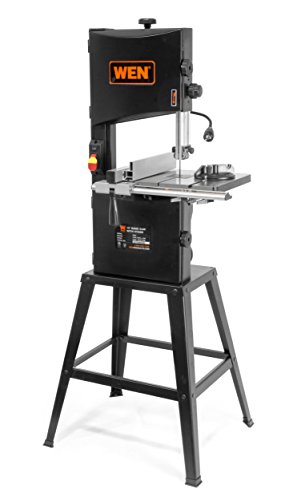
“Benchtop bandsaw height” can mean the machine’s overall height, the maximum workpiece height beneath the guides, or the height of its table above the floor. Those measurements answer different questions. Overall height affects storage; cutting height limits the stock opening; working height depends on the bench or stand. Keep them separate when comparing models or planning a shop. A tall cabinet does not necessarily create more resaw capacity, and a compact housing does not guarantee comfortable use.
As an Amazon Associate I earn from qualifying purchases. How affiliate links work.
Measure the housing for the space it occupies
Overall height usually describes the assembled machine itself, but check whether a listing includes a supplied stand or accessory. Your space also needs clearance to open wheel doors, turn adjustment controls, remove the blade, and access the power connection. Measure those access needs in addition to the closed-machine envelope. A shelf that clears the top housing may still obstruct the tension knob. A storage bay that accepts the saw may not be a location where the saw can be set up and used.
Read cutting height as an opening limit
The cutting-height specification concerns the space available above the table with the guide assembly raised as permitted. It is particularly relevant when a board stands on edge for resawing. Allow for the actual blank, including irregularities and any carrier beneath it. Do not remove or alter guards to accommodate taller stock. Physical clearance is only one condition: the motor, blade, stock characteristics, and feed also influence whether a cut is practical. Maximum height does not provide a universal production capability.
Calculate the table’s working elevation
For a true benchtop installation, add the bench height to the saw’s base-to-table distance. Include any approved mounting arrangement that changes that distance. Then assess the result with the stock you actually handle. You should be able to see the line and guide the piece without excessive stooping or raised shoulders. CCOHS identifies a suitable bench height as part of secure installation. There is no single floor-to-table number that is comfortable for every operator, task, and workpiece size.
Check visibility without changing the guard’s job
A poor view of the cutting line can tempt an operator to raise the guide assembly unnecessarily. Solve the cause instead: improve appropriate task lighting, reposition yourself, or reconsider the bench arrangement. Set the adjustable guard according to the manual and the current stock thickness. It is not an ergonomic height adjustment for the user. Test your sightline with power disconnected and the work in its planned position. Include any fence, carrier, or clamp that could block the view during an actual cut.
Plan loading, service access and a useful comparison
A stable mounting surface needs sufficient support for the machine and the forces created by handling stock. Follow the saw maker’s mounting instructions instead of relying on an unsecured placement. Leave access to fasteners and maintenance points. If the saw will be stored elsewhere, plan the move with its actual weight, balance, and lifting guidance in mind. Frequent lifting can erase the apparent convenience of a small footprint. A dedicated stand may be more workable than a tall shared bench even when both fit the room.
Make separate entries for machine-only height, stand-inclusive height if relevant, cutting height, and the proposed floor-to-table result. Add door-opening space and the largest routine blank’s travel envelope. Mark unknown measurements as unknown instead of substituting a similarly named model’s number. This makes a comparison auditable and shows which question still needs a manual or manufacturer answer. It also prevents a common mistake: choosing a saw because it fits on a shelf while discovering that routine cutting and blade changes require moving it elsewhere.
Questions about Benchtop Bandsaw Height: Three Measurements That Matter
Which bandsaw height measurement matters?
Overall machine height, maximum cutting height and working table height answer different questions. Use cutting height for stock clearance, overall height for storage and table height for installation planning.
Does cutting height equal resaw performance?
No. It establishes physical clearance. Blade selection, power, wood characteristics, support and feed determine how effectively the saw can perform a particular resaw.
Should every bandsaw table be at the same height?
No. Operator size and the task matter. Follow mounting instructions, then evaluate posture, visibility, stock support and access to controls for your installation.