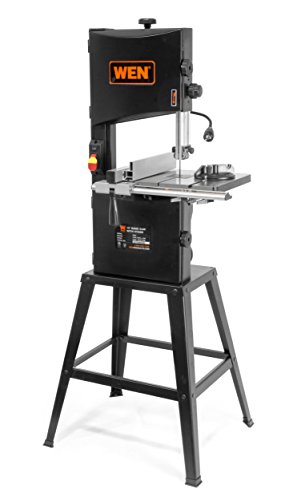
guides
Resawing on a Benchtop Bandsaw: A Practical Workflow
Resawing divides a board into thinner boards by cutting through its thickness while it stands on edge. A compact saw can handle appropriately sized work only when the board clears with practical margin, its reference surfaces are stable, the exact machine supports the selected blade, and the material plan includes kerf plus surfacing loss. Maximum opening is a clearance limit—not a promise of straight, repeatable cuts at that height.
Plan this decision
Estimate finished-board yield
Use actual stock and finished thickness, one fewer kerf than produced boards, and a separate total surfacing allowance for every board.
Choose the machine class
Compare exact compact capacities and blade systems, then include a floor saw when routine work sits at the compact envelope.
Check exact blade dimensions
Confirm the model’s loop and permitted width range before researching tooth form, pitch and backing thickness for the cut.
As an Amazon Associate I earn from qualifying purchases. How affiliate links work.
Calculate kerf and surfacing loss before cutting
Work backward from the required finished thickness. Producing n boards takes n−1 separating cuts, so the thickness plan is: n times the finished thickness, plus n times the total surfacing allowance per board, plus n−1 blade kerfs. The Resaw Yield calculator applies that relationship. Its remainder is unallocated thickness, not a promise that defects, stress, lead or an extra truing cut will fit.
Use the actual starting thickness after flattening any required reference face—not a nominal lumber label. Measure kerf from the blade and setup when practical, or record a current quoted value as an estimate. Keep surfacing allowance separate because it accounts for material removed after sawing. A plan with almost no remainder has no useful recovery margin when the first face needs more correction than expected.
Establish references before selecting the blade
The board needs a dependable relationship with the table and whichever fence or guiding method the exact manual permits. A twisted face or uneven supporting edge can make the blank rock and create changing thickness even when the blade runs correctly. Prepare the reference face and supporting edge by an appropriate process. Reject or correct loose knots, metal, severe warp and other conditions identified by the machine manual before attempting the cut.
Plan support for the board’s full travel without lifting the work at the outfeed. Keep hands away from the possible exit path of a wandering blade. Grizzly’s G0948 manual specifically warns that blade lead can break through the side of thin resawn work and directs the operator to use push blocks and keep hands clear. A tall fence or outfeed stand is useful only when it maintains control without contradicting the exact machine instructions.
Select and reset the complete blade system
Follow the exact model’s loop, width and thickness limits before choosing teeth. G0948’s manual says a wider blade tends to cut straighter and resist blade lead, but G0948 itself permits only 1/8- to 1/2-inch widths. Its general chart’s wider category does not override that model limit. Choose tooth form and pitch for the stock depth and material with the blade supplier so the gullets can carry waste without forcing the feed.
After changing the blade, reset tracking, tension and guides in the manual’s sequence. G0948 requires its guide and support bearings to be readjusted after a blade, tension or tracking change. It also places the upper guide no more than 1/4 inch above the work. The retained RIKON 10-306 manual likewise uses approximately 1/4 inch, but another model’s manual remains controlling; do not turn these two examples into a universal setting.
Test the fence relationship on comparable stock
Set up the saw according to its manual, then test a supported offcut with similar height and material. Inspect both faces after stopping. Thickness changing along the length, across the height or only near the exit can point to different questions about blade condition, tension, fence relationship and support. Resolve unexplained taper before cutting stock that cannot spare the loss.
Do not skew a fence by guesswork as the first response. G0948’s service procedure first calls for proper blade tension and guide adjustment, less feed pressure, and confirmation that the fence and miter slot follow the blade line. Its fence-skew procedure follows only if lead remains. Use the procedure for your exact machine; a fixed fence, single-point guide or another model may require a different documented approach.
Feed by the cutting response, not the opening label
Use the approved fence or guiding arrangement and suitable push devices. Maintain controlled feed without forcing the blade to deflect. A published six-inch opening only says the stock can clear the guide; it does not establish the feed rate, surface quality or repetition the machine can sustain in a particular species. Grizzly's current G0948 FAQ, for example, says four-inch hardwood is slow on that 6-1/8-inch-capacity model and recommends a larger saw for frequent work at that thickness. If the saw slows markedly, the cut wanders or control becomes uncertain, stop and diagnose the blade and setup.
Never reach around the blade to pull the emerging board. Plan what to do if the cut must stop partway through and wait until blade motion has ceased before freeing the work. Tall stock can hide the blade inside the kerf, so establish hand and push-block paths before switching on. Repeated maximum-height work that demands pressure or frequent correction is a reason to compare a larger machine, not to push harder.
Evaluate the pieces before the next pass
Label the newly exposed faces and measure each blank before another pass. Internal stress can appear after material is removed, so a sawn face does not automatically become the next reference without assessment. Let the pieces condition as the project requires, then flatten and thickness them using the allowance assigned before cutting.
Compare actual yield with the plan: finished boards, measured kerf, surfacing loss and unallocated remainder. Record the blade identity, stock dimensions and result. If repeated full-height cuts consume excessive correction or demand uncertain control, use narrower stock, buy prepared material, outsource the resawing or choose a machine whose documented blade and support system better suits the recurring work.
Questions about Resawing on a Benchtop Bandsaw: A Practical Workflow
How thick can I resaw on a benchtop bandsaw?
Check the exact model’s cutting height, then account for roughness, reference preparation and any manual-approved carrier. Clearance only screens physical fit; blade, setup, stock and support determine whether the cut is credible.
Why are my resawn boards wedge-shaped?
A changing reference surface, blade deflection, guiding error, or unsuitable blade can contribute. Measure where the taper occurs and diagnose it on comparable scrap before adjusting several settings.
Why does the yield calculator use one fewer kerf than boards?
One separating cut creates two boards; in general, producing n boards requires n−1 cuts. Surfacing allowance is still applied to every finished board.