buying guides
Best Benchtop Bandsaw for Resawing: Know the Limits
The best benchtop bandsaw for resawing is the smallest documented machine that clears the board standing on edge, accepts a suitable blade, and leaves enough practical margin for support and controlled feed. Opening height is only a clearance gate. It does not prove repeatable performance at that height, and it says nothing about how many finished boards remain after kerf and surfacing loss.
Plan this decision
Calculate finished-board yield
Enter starting thickness, finished thickness, measured or quoted kerf and per-board surfacing allowance. The calculator uses one fewer kerf than the number of finished boards.
Filter documented cutting height
Use board width in the cutting orientation as the height requirement. A match is a dimensional shortlist, not a resaw-performance or safety approval.
Plan the operating workflow
Prepare reference faces, select and set the blade from the exact manual, test comparable stock and stop when lead or feed pressure becomes uncertain.
As an Amazon Associate I earn from qualifying purchases. How affiliate links work.
Some compared models have no matched Amazon offer. Check each row and model guide; alternative listings are not exact offers for missing models.
Side-by-side buying comparison
| Model | Machine family | Cut height (in) | Throat (in) | Blade length (in) | Blade width range (in) | Offer |
|---|---|---|---|---|---|---|
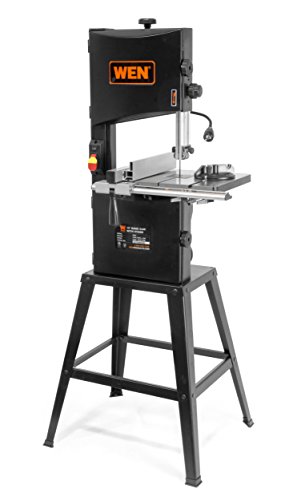
| WEN BA3962 | Compact woodworking | 6 | 9.75 | 72 | 0.125–0.5 | Check Amazon offer |
| Grizzly G0948 | Compact woodworking | 6.125 | 9.75 | 72 | 0.125–0.5 | No exact offer matched |
| RIKON 10-3062S | Compact woodworking | 5 | 9.625 | 70.5 | 0.125–0.5 | Check Amazon offer |
Check the model guides for regional variations and source qualifications. Table dimensions do not establish performance or material suitability.
Measure the board in its cutting orientation
Resawing separates a board through its thickness, usually with the board standing on edge. The vertical dimension during the cut is therefore the board’s width, not the thickness of the finished slice. This simple distinction prevents many unsuitable purchases. Also account for the reference surface and any support arrangement needed to keep the piece controlled.
Measure the rough stock you intend to use rather than relying on nominal sale dimensions. Record board width in the cutting orientation, starting thickness, target finished thickness and the longest board that must remain supported. Irregularity, bow and an unprepared edge can consume clearance or make the setup unstable. A maximum opening is a clearance statement, not proof that every board of that width is a credible repeated job.
Shortlist capacity without claiming a tested winner
The current WEN BA3962 page documents a six-inch opening, 72-inch loop and 1/8- to 1/2-inch blade range. Grizzly documents 6-1/8 inches for G0948, the same nominal 72-inch loop and width range, plus an included resaw-fence attachment. RIKON documents five inches, a 70-1/2-inch loop and the same 1/8- to 1/2-inch width range for 10-3062/10-3062S. These are exact-model shopping differences, not a controlled cut-quality ranking.
Choose from those candidates only after deciding how often the upper part of the envelope matters. Grizzly's current G0948 FAQ says four-inch hardwood is slow even with a coarse three-TPI blade and points frequent four-inch work toward a larger saw. That is model-specific manufacturer guidance, not a universal horsepower rule, but it shows why a 6-1/8-inch opening cannot be read as a repeatable-performance rating. If typical stock merely squeezes under the guide, include a floor model before deciding rather than solving clearance while leaving support, blade and workload constraints unresolved.
Budget the material loss before comparing saws
Start with finished parts rather than the number of slices you hope to see. Each produced board consumes its finished thickness plus its own total surfacing allowance. The saw consumes one fewer kerf than the number of boards because producing n boards requires n−1 separating cuts. The site’s yield calculator uses that relationship and reports unallocated thickness; it does not hide drift, defects or extra truing cuts inside the answer.
Use a measured kerf from the actual blade and setup when possible, or a current quoted kerf that you explicitly label as an estimate. Keep surfacing allowance separate from kerf. If the arithmetic leaves almost nothing unallocated, one wandering cut, internal stress or rough face can erase the planned result. That is a material-plan failure, not evidence that a saw with a taller opening would recover the missing thickness.
Treat blade and guide setup as part of the purchase
Grizzly’s G0948 manual says resawing favors a wider blade because it cuts straighter and is less prone to blade lead, but the exact machine still caps blade width at 1/2 inch. Its selection chart is general guidance, not permission to install the chart’s 3/4-inch category on G0948. Stay inside the exact model’s width and thickness limits, then choose tooth pitch and form for the board depth and material with the blade supplier.
Plan to reset the guides after a blade change. G0948’s manual requires the upper guide to clear the work by no more than 1/4 inch and requires guide/support-bearing readjustment after changing blade, tension or tracking. RIKON’s retained 10-306 manual likewise places its upper guide about 1/4 inch above the work. These are model instructions, not a universal value to transfer to every saw.
Choose a compact saw only when the whole process fits
A tall board needs stable reference faces and appropriate infeed and outfeed support. A taller fence accessory cannot make twisted stock stable, and nominal motor labels do not establish throughput in a specific species. Price the task-specific blade, support, dust connection and downstream flattening or thicknessing along with the saw. An apparently inexpensive machine is not a complete resaw system by itself.
Choose a compact saw when the recurring boards fit with margin and the full preparation, test-cut, feeding and surfacing process is credible. Compare a floor saw, prepared lumber or outsourced resawing when typical work sits at the limit, demands a blade the compact machine cannot support, or repeatedly consumes excessive correction. That decision is more useful than declaring one compact model the universal best.
Questions about Best Benchtop Bandsaw for Resawing: Know the Limits
What is the best benchtop bandsaw for resawing?
Compare WEN BA3962, Grizzly G0948 and RIKON 10-3062S against board width in the cutting orientation, supported blade range and workload frequency. There is no documented universal winner; repeated work at the compact machine’s limit deserves a floor-saw comparison.
Does maximum cutting height equal easy resaw capacity?
No. It establishes clearance. Blade selection, power under load, reference faces, support, material, and repetition determine whether that height is practical for your work.
How many kerfs should a resaw-yield estimate count?
Producing n finished boards requires n−1 separating cuts, so the estimate uses one fewer kerf than boards. It separately applies surfacing allowance to every board.