accessories
Bandsaw Stands: Stable Height and Real Compatibility
A stand should put the saw at a comfortable working height while keeping the machine and workpiece stable. Its load rating is only the beginning. Mounting geometry, footprint, bracing, floor contact, and access around the saw determine whether it will work in your shop. Also distinguish an ordinary machine stand from an adapter that converts a handheld metal bandsaw into a stationary arrangement; they solve different problems.
As an Amazon Associate I earn from qualifying purchases. How affiliate links work.
Start from finished table height
Measure the distance from the saw’s mounting surface to its table. Add the proposed stand height, including any mounting board and feet, to find the actual work height. A stand that looks low in a catalog can still put a compact saw’s table uncomfortably high.
Consider the work itself. Small detail cutting calls for good visibility without forcing your shoulders upward, while larger stock needs room for controlled support. Mock up the proposed height with a safe nonoperating arrangement or a dimensioned sketch before buying. If the stand is adjustable, check its usable height range under the intended load rather than assuming every advertised position suits every tool.
Check mounting and stability separately
A high weight rating does not confirm that the stand’s top accepts the saw’s bolt pattern. Record mounting-hole spacing and the footprint of the machine base. If a board is required, include its size, fasteners, and the stand manufacturer’s mounting guidance in the plan.
Then examine the floor footprint and bracing. A narrow stand can feel different when a long board or metal section extends to one side. The stand supports the machine; it does not automatically support all projecting stock. Plan separate material supports suited to the job and align them with the saw’s working surface. Avoid choosing the stand solely by how little floor space it occupies.
Think through movement and storage
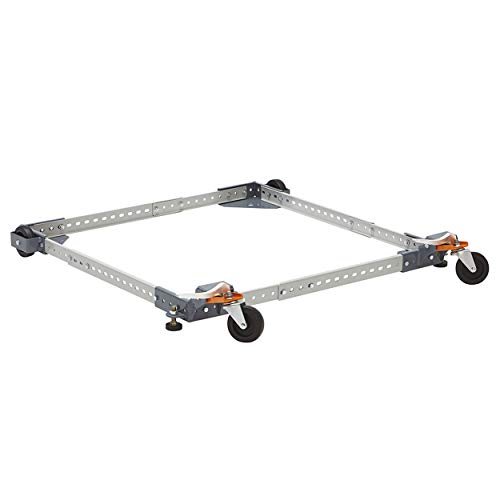
Wheels make relocation easier, but the stand must have a secure working configuration. Compare how casters lock or retract and whether the saw rests on stable feet during use. A mobile base that works well beneath a broad cabinet may be a poor match for a tall, narrow benchtop stand.
For folding stands, check whether the saw can remain mounted when folded and how the assembly is moved according to the maker’s instructions. Do not assume a stand sold for miter saws is suitable for your bandsaw just because universal appears in the title. BORA lists multi-tool mounting on some stands, but the actual tool attachment and working height still need confirmation.
Keep portable metal-saw conversions in their own category
A Portaband table or pivoting base is an adapter for a handheld saw. It may provide a vertical table or a vise-supported cutoff arrangement, but it does not turn the tool into a conventional woodworking bandsaw. Its saw compatibility, attachment points, controls, and guarding need their own review.
The adapter’s weight and dimensions also belong in the support calculation. A vise-mounted table depends on the vise and bench beneath it. A freestanding table needs its own stability assessment. Do not compare the price of a bare handheld saw with the price of a complete dedicated metal machine without adding the required mounting equipment.
Before checkout, trace the whole support system from floor to workpiece: stand, feet or casters, mounting top, fasteners, saw, and external stock supports. Check clear access to the switch, doors, blade changes, and table tilt. A stand succeeds when those ordinary tasks remain easy, not merely when the machine can be bolted on.
Include the objects stored beneath the stand in the layout check. A shelf full of supplies may block access to mounting fasteners or make relocation awkward. Conversely, an empty open stand may offer useful clearance for the operator’s stance. Choose storage as part of the stand’s intended design, and keep any added load within its instructions. The best arrangement leaves ordinary machine access straightforward after the shop is fully equipped.
Questions about Bandsaw Stands: Stable Height and Real Compatibility
Is weight capacity enough to choose a stand?
No. Mounting pattern, footprint, bracing, work height, and projecting stock all affect suitability.
Can I use a miter-saw stand?
Only when its manufacturer supports the mounting arrangement and the resulting height and stability suit the bandsaw.
Is a Portaband table a normal bandsaw stand?
No. It is a model-compatible conversion accessory for a handheld metal saw and must be evaluated with that tool.