comparisons
9-Inch vs 10-Inch Bandsaw: More Than One Inch
A 10-inch bandsaw can differ much more from a 9-inch saw than the label suggests, but not every 10-inch model supplies six inches of clearance or the same blade loop. Choose the exact opening, throat, blade system and installed support your normal projects require; nominal wheel size is only a catalog starting point.
Plan this decision
Compare exact models
Check documented height, throat and blade systems without treating a 9-inch or 10-inch label as a specification.
Verify the blade system
Look up the exact loop and permitted width range before comparing teeth, material or marketplace listings.
Plan the installed footprint
Compare a compact bench station with the supplied-stand alternatives using actual footprints and chosen clearances.
As an Amazon Associate I earn from qualifying purchases. How affiliate links work.
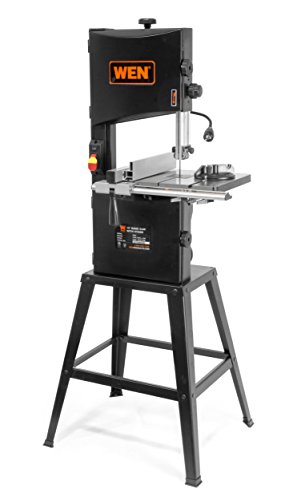
WEN BA3959 and BA3962 are the exact retained offer examples. Grizzly G0803Z and G0948 are source-only comparison models here; no different listing is presented as an exact match.
Side-by-side buying comparison
| Model | Machine family | Cut height (in) | Throat (in) | Blade length (in) | Blade width range (in) | Offer |
|---|---|---|---|---|---|---|
| WEN BA3959 | Compact woodworking | 3.5 | 9 | 59.5 | 0.125–0.375 | Check Amazon offer |
| Grizzly G0803Z | Compact woodworking | 3.625 | 9 | 62 | 0.125–0.375 | No exact offer matched |
| WEN BA3962 | Compact woodworking | 6 | 9.75 | 72 | 0.125–0.5 | Check Amazon offer |
| Grizzly G0948 | Compact woodworking | 6.125 | 9.75 | 72 | 0.125–0.5 | No exact offer matched |
Check the model guides for regional variations and source qualifications. Table dimensions do not establish performance or material suitability.
Why wheel size is an incomplete comparison
The size in a bandsaw name generally relates to its wheels and frame scale, not the stock thickness it will cut. WEN's BA3959 and BA3962 illustrate the possible jump: 3.5 versus six inches of documented cutting height, nine versus 9.75 inches of throat and 59.5- versus 72-inch blade loops. That is a comparison between two exact models, not a rule that every 10-inch saw doubles every 9-inch model's useful envelope.
The same nominal class can hide incompatible systems. The 9-inch BA3959 uses a 59.5-inch loop, while Grizzly's 9-inch G0803Z uses 62 inches. Among compact 10-inch choices, RIKON's 10-3062S uses a 70.5-inch loop and documents five inches of height, while Grizzly's G0948 uses a 72-inch loop and documents 6.125 inches. Buy blades and capacity from the model record, not the wheel-size label.
Decide whether the extra height serves your work
A 9-inch saw remains a rational choice when normal stock clears the exact opening comfortably, the permitted blade range covers the curves and the machine fits a stable bench station. Thin templates and small curved parts may gain nothing from unused height. In that case, blade availability, guide procedure, dust connection and the room to turn the work can be more important than moving up one nominal size.
Choose a 10-inch model only when its documented difference serves a defined job: more height for a board standing on edge, more inward reach, a wider permitted blade or a supplied stand that solves the station plan. If recurring stock is already close to that model's maximum opening, move to the separate compact-versus-floor comparison instead of treating 10 inches as the endpoint. Clearance is not a controlled resawing result.
Blade length and width are separate decisions
Nominal machine size does not define one universal blade. Two 9-inch saws can require 59.5- and 62-inch loops, while compact 10-inch models in this guide use 70.5- or 72-inch loops. Before purchasing a spare, verify length, permitted width, thickness requirements, tooth form, speed and intended material in the exact manual. A listing described only as benchtop or 10-inch is not enough.
The required curve radius influences width choice, while stock thickness and material influence tooth selection. A wider permitted blade can be useful for some straight work but does not guarantee clean resawing. Tension capability, guide setup, tooth condition, and steady support remain important. Buy a larger category for a documented work requirement rather than assuming every blade specification represents an automatic performance improvement.
Compare complete installations side by side
The exact WEN pair also shows the installation change: the BA3959 is listed at 40 pounds for a stable bench, while the BA3962 is listed at 73.5 pounds with a supplied stand. Weight is not a cut-quality score, but it affects lifting, storage and whether the saw can realistically be cleared from a shared surface. A smaller saw on a large cabinet can occupy more useful room than a stand-equipped 10-inch station.
Calculate final table height, stock path, wheel-door access, dust hose route and any required mounting hardware. If both models clear the project brief, compare adjustment procedures, exact blade supply and service documentation. If only one clears it with reasonable working room, prioritize that documented difference over a minor included accessory.
Questions about 9-Inch vs 10-Inch Bandsaw: More Than One Inch
Is a 10-inch bandsaw much better than a 9-inch?
It may provide substantially more useful height, but the difference depends on the exact models. For thin small parts, additional capacity may offer little benefit compared with better station access or a suitable blade.
Do all 9-inch bandsaws use the same blade?
No. Nominal wheel size does not establish blade length. Check the exact model manual before ordering a replacement.
Should I skip the 9-inch category for resawing?
If resawing is a recurring objective, compare actual height and workload suitability carefully. A taller compact model may help, while demanding wide-board work can justify a larger floor machine.