buying guides
Best Benchtop Bandsaw: Choose by the Cuts You Make
The best benchtop bandsaw is the smallest documented machine that clears your non-negotiable recurring cuts, accepts the blade system those cuts need, and fits a complete working station. Published opening height is a clearance limit, not proof of repeatable resaw performance. This five-model shortlist uses manufacturer specifications and retained exact offers, not claimed hands-on testing.
As an Amazon Associate I earn from qualifying purchases. How affiliate links work.
The retained catalog provides exact offers for WEN BA3959, WEN BA3962 and RIKON 10-3062S. SKIL BW9501-00 and Grizzly G0948 are source-only candidates with no exact retained Amazon offer; a similar listing is not presented as a substitute.
Side-by-side buying comparison
| Model | Machine family | Cut height (in) | Throat (in) | Blade length (in) | Blade width range (in) | Offer |
|---|---|---|---|---|---|---|
| WEN BA3959 | Compact woodworking | 3.5 | 9 | 59.5 | 0.125–0.375 | Check Amazon offer |
| WEN BA3962 | Compact woodworking | 6 | 9.75 | 72 | 0.125–0.5 | Check Amazon offer |
| RIKON 10-3062S | Compact woodworking | 5 | 9.625 | 70.5 | 0.125–0.5 | Check Amazon offer |
| SKIL BW9501-00 | Compact woodworking | 3.5 | 9 | 59.5 | 0.125–0.375 | No exact offer matched |
| Grizzly G0948 | Compact woodworking | 6.125 | 9.75 | 72 | 0.125–0.5 | No exact offer matched |
Check the model guides for regional variations and source qualifications. Table dimensions do not establish performance or material suitability.
Use six elimination gates before comparing features
Write down three recurring cuts. For each, record stock height, inward reach from the nearest edge, the smallest curve radius or need for a straight resaw face, material, and the space needed to support the board. Use those requirements to eliminate machines before comparing convenience features. A saw can clear the stock under its guide yet lack enough throat to turn the shape or enough station room to support the cut.
Then check the exact manual for the blade loop, permitted width and thickness, tooth form and material, speed settings, guarding, and supported work. Blade length alone does not establish compatibility. Finish with the installed footprint: doors must open, the table and guides must remain reachable, and the support and dust hose cannot make the cut impractical.
- Required stock height and inward reach, measured from the real cut path
- Smallest curve radius or straight-resaw need, translated into a supported blade width
- Exact blade length, width, thickness, tooth form, material and speed requirements
- Machine family and exact manual support for the intended material and operation
- Bench, door, table-tilt, work-support and dust-hose clearance
- Complete setup budget for the saw, blades, mounting, extraction and support
Choose a 9-inch saw for compact work, not imaginary reserve
The WEN BA3959 is the exact-offer 9-inch candidate here: WEN documents a 3-1/2-inch opening, 9-inch throat, 59-1/2-inch blade loop, 1/8- to 3/8-inch blade-width range and one 2,500 FPM setting. It is the clearer fit when thin stock, compact curves and a small dedicated station describe the recurring work. Stop if stock must regularly exceed 3-1/2 inches or the intended cut needs a wider blade than the manual permits.
The SKIL BW9501-00 is a source-only alternative with no exact retained Amazon offer. Its current documentation supports the same 3-1/2-inch opening and 9-inch throat class, a 59-1/2-inch nominal blade system and two speeds. Do not transfer those details to the legacy 3386-01. SKIL's webpage and manual also differ on some table and blade-loop details, and a confirmed machine weight is unavailable, so verify the supplied manual and nameplate when those values decide the installation.
Choose a 10-inch saw for a documented requirement
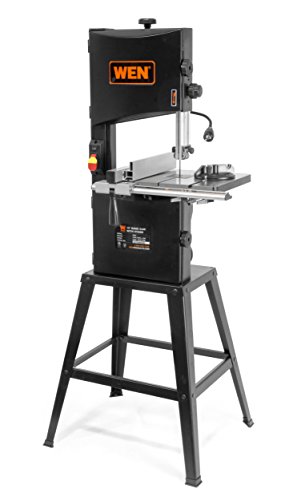
The WEN BA3962 is the exact-offer choice when the project list needs its documented 6-inch opening, 9-3/4-inch throat, 72-inch loop, 1/8- to 1/2-inch width range or 1,520/2,620 FPM settings. It includes a stand, so compare its whole station with a bench-mounted alternative instead of treating the stand as free space. Do not choose it only because ten inches sounds safer for future projects.
The exact-offer RIKON 10-3062S trades some opening height—5 inches—for a documented 9-5/8-inch throat, 70-1/2-inch loop, 1/8- to 1/2-inch width range, tool-less guides and quick-release tension. RIKON's current page uses 3,250 FPM in marketing copy and 3,280 FPM in the technical table; preserve that revision conflict when the upper speed matters. The Grizzly G0948 is a source-only 72-inch-loop alternative with a documented 6-1/8-inch opening, 9-3/4-inch throat and two speeds, but no quick-release tension and no exact retained Amazon offer.
Separate opening capacity from resaw performance
Nominal wheel size, throat and opening height describe different dimensions. Opening height tells you whether stock can physically pass under the raised guide. It does not prove the saw, blade and support system will produce a controlled, repeatable resaw at that height. Blade selection and condition, tension, guide setup, stock preparation, feed control, fence strategy and infeed/outfeed support all affect the result.
Treat work near a machine's published maximum as a reason to investigate, not as a promised capability. If most planned work sits close to the limit, compare a larger floor machine and its support requirements. Capacity margin is useful only when it serves an actual project and the complete system remains practical.
Check the blade ecosystem before choosing the saw
These candidates use three different blade loops: 59-1/2 inches for the BA3959 and nominally the BW9501-00, 72 inches for the BA3962 and G0948, and 70-1/2 inches for the RIKON 10-3062S. They are not interchangeable families. Before choosing a machine, confirm that the required loop is obtainable in a manual-supported width, thickness, tooth form and material for the intended cut.
Use the blade Finder to locate documented machine dimensions, then verify the exact machine manual and blade listing. A search result that matches only length is not a compatibility certificate. Replacement tires, inserts, guides and belts should also be checked by exact model and revision rather than assumed universal.
Five-model stop rules
WEN BA3959: choose it for thin stock, compact curves and a small station when a 3-1/2-inch opening and 3/8-inch maximum documented blade width are enough. Stop when the recurring stock or required blade exceeds either limit. SKIL BW9501-00: choose it only when its two-speed 9-inch format and 59-1/2-inch ecosystem fit and you can verify the current exact machine documentation. Stop when you need an exact retained offer, confirmed weight or are looking at the different legacy 3386-01.
WEN BA3962: choose it when a 6-inch opening, 72-inch loop, two speeds and included stand solve documented needs. Stop when a bench-only footprint is required or recurring work near 6 inches lacks a credible performance and support plan. RIKON 10-3062S: choose it when tool-less guides, quick-release tension and its 5-inch opening matter more than maximum clearance. Stop when you need more than 5 inches or a revision conflict affects the job. Grizzly G0948: choose it as a source-backed woodworking candidate when its 6-1/8-inch opening, 72-inch loop and two speeds fit. Stop when quick-release tension or an exact retained Amazon offer is required.
Price the complete station before ordering
Budget for secure mounting or the supplied stand, the first task-specific blade, extraction connections, lighting and stock support. A lower machine price can lose its advantage if the working station needs a cabinet or costly changes; an included stand can also be the wrong answer when floor space is the binding constraint. Use current quotes in the setup-budget tool rather than relying on an old price claim.
Before ordering, read the blade-change, guide-adjustment and guarding sections of the exact manual. Confirm that doors can open, the table can tilt, lower guides remain reachable and supported stock has a safe path in the proposed location. Buy only when no stop rule is triggered and the capacity margin serves a named project.
Questions about Best Benchtop Bandsaw: Choose by the Cuts You Make
What is the best benchtop bandsaw?
For thin stock and compact curves, compare documented 9-inch systems such as WEN BA3959 and SKIL BW9501-00. For a larger opening or wider supported blades, compare WEN BA3962, RIKON 10-3062S and Grizzly G0948. Eliminate any model that fails the required height, throat, blade or installed-space gate.
Does maximum cutting height mean a bandsaw can resaw that height well?
No. Maximum opening is a clearance value, not a resaw-performance guarantee. Blade selection and condition, tension, guides, stock preparation, feed control, fence strategy and work support still determine whether the cut is controlled and repeatable.
Does a higher motor rating guarantee cleaner cuts?
No. Blade condition, tooth selection, tension, alignment, support, and feed rate all influence the result. Electrical input ratings alone are a poor prediction of finish quality.
Should I buy a bandsaw before a table saw?
Choose the tool that removes your current project bottleneck. Curved solid-wood parts favor a bandsaw; repeatable sheet and board sizing may favor a table saw or another straight-cutting system.
What should I do when a compared bandsaw has no exact Amazon offer?
Use the source-backed model guide to decide whether the machine fits, then verify an exact seller listing separately. Do not treat another model, bundle or similar-looking saw as an exact substitute merely to create a purchase link.