guides
What Is a Benchtop Band Saw Used For?
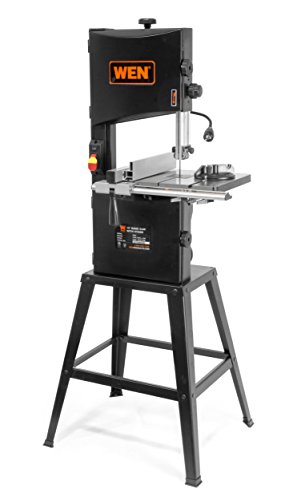
A benchtop band saw is a compact stationary saw that carries a continuous toothed blade around wheels. In a woodworking shop, its useful jobs include cutting outside curves, roughing out shaped parts, ripping manageable boards, and limited resawing. The important word is manageable: the board must fit the cutting opening and remain supported throughout the cut. Choosing a project by those conditions gives a much clearer answer than calling the machine an all-purpose saw.
As an Amazon Associate I earn from qualifying purchases. How affiliate links work.
Good fits: shaped parts and project stock
A curved bracket, an arched box handle, and a furniture template share a useful workflow: mark the finished profile, remove waste outside the line, then refine the edge with an appropriate finishing tool. The bandsaw performs the rough shaping stage. It does not need to leave a perfectly finished edge to save work. A narrow blade can follow a tighter curve than a broad blade, but the actual minimum radius comes from the blade maker’s guidance and the saw’s permitted blade range.
Straight cuts let you reduce a board to a useful width, divide short blanks, or prepare strips for later planing. Resawing is a different orientation: the board stands on its edge while the blade divides its thickness. That exposes a taller face to the cut and makes support, blade suitability, and available cutting height more demanding. Treat a manufacturer’s maximum opening as a physical limit, not a promise that every species and blade will cut comfortably at that height.
Decide what needs another machine
A full plywood sheet may technically contain sections smaller than the throat, yet the sheet itself is difficult to support and turn on a compact table. Break it down with a suitable supported method first. Internal cutouts with no entry path are another limitation because a bandsaw uses a closed loop; a scroll saw or another appropriate tool may fit the design better. Long production rips and repeated full-capacity hardwood resawing can also justify a different machine, even when an occasional small cut is possible.
Match the setup to the operation
The same blade is unlikely to be ideal for a tight decorative curve and a tall straight resaw. Think about material thickness, curve radius, surface requirements, and the amount of waste removed before installing a blade. Use the exact machine manual for permitted length, width, thickness, tracking, and guide settings. Grizzly’s benchtop manual distinguishes ripping, resawing, and curve cutting as separate operations. That distinction is useful when planning a project because changing the cut changes the demands on the setup.
Give the work somewhere to go
Before switching on, move the work through its planned path with the saw isolated from power. Check whether the far end will hit a wall, a clamp will meet the frame, or an offcut will become awkward to control. Small parts may need a purpose-built carrier; round stock requires restraint against rotation. Position the adjustable guard as the model instructs, close the wheel covers, and keep the operator’s hands outside the blade path. If a cut cannot be supported predictably, redesign the operation before attempting it.
Plan an achievable first project
A useful first exercise is a flat, comfortably sized blank with one broad outside curve. It asks for layout, controlled feeding, and finishing allowance without combining tall stock, tight turns, and delicate offcuts. Evaluate whether the blade follows the waste side of the line and whether the blank stays stable. Move on to straight cuts and more involved shapes as those habits become repeatable. Project success should mean an accurately prepared part and a controlled process, rather than the smallest possible offcut or the fastest possible feed.
Questions about What Is a Benchtop Band Saw Used For?
What is a benchtop band saw used for?
It is used for supported woodworking cuts such as outside curves, rough shaping, ripping and modest resawing within the model’s capacity. Each operation needs a suitable blade and workholding plan.
Which projects suit a benchtop bandsaw?
Outside curves, rough shaping, narrow ripping and limited resawing are common fits when the blank stays supported and fits the saw’s height and throat. Internal cutouts, full sheets and unsupported long stock usually call for another method.
Can it make a finished furniture joint?
It can rough out some joinery, but the blade, setup and joint determine how much refinement is needed. Plan for fitting and finishing instead of assuming a glue-ready surface.