models
Shop Fox W1749: A Legacy 9-Inch Benchtop Saw Guide
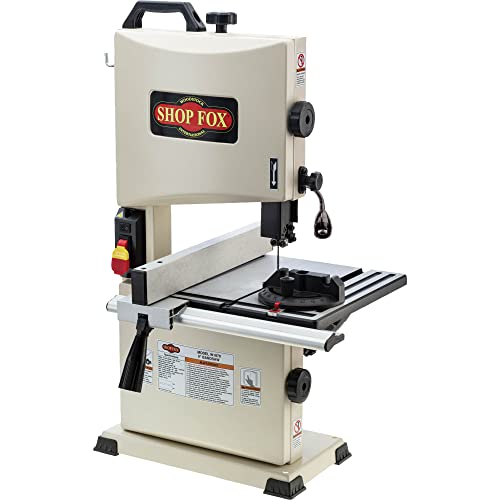
The Shop Fox W1749 is an earlier nine-inch benchtop woodworking bandsaw, distinct from both the later W1878 and the much larger W1706 floor model. Its official manual and specification sheet remain useful for owners and secondhand buyers. The identity check starts with its 59-1/4-inch blade and 3/8-inch maximum width; neither belongs to the W1878's 62-inch system.
As an Amazon Associate I earn from qualifying purchases. How affiliate links work.
The retained catalog has no verified W1749 match. The same-brand Shop Fox listing below has not been established as the model in this guide.
Documented specifications for Shop Fox W1749
| Model | Machine family | Cut height (in) | Throat (in) | Blade length (in) | Blade width range (in) | Offer |
|---|---|---|---|---|---|---|
| Shop Fox W1749 | Compact woodworking | 3.5 | 9 | 59.25 | 0.125–0.375 | No exact offer matched |
- Table dimensions
- 11.5 × 11.5 in
- Machine weight
- 42 lb
- Blade speed
- 2559 FPM
Legacy nine-inch woodworking model with steel guide blocks and a 2-1/2-inch dust port.
Official maximum blade width is 3/8in; do not use third-party 1/2in claims.
Distinct from W1878: 59-1/4-inch blade rather than 62 inches; exact offer is not retained.
Small-machine identity matters more than the brand badge
The W1749 specification sheet gives a nine-inch cutting width, 3-1/2-inch cutting height, an 11-1/2-inch square table and a 2,559-FPM blade speed. It lists a 1/3 HP 110 V motor, 42-pound net weight, steel guide blocks and a 2-1/2-inch dust port. This is a compact craft and small-woodworking envelope, not a scaled-down version of every feature found on a fourteen-inch Shop Fox.
Check the model plate on a used machine before applying these figures. A seller may know the brand but not the full number. Photographing the label, front table area, and lower guide assembly helps establish what is present. The exact designation is also necessary when searching for an insert, tire, guide block, or replacement switch.
Use the official blade-width limit
The manufacturer lists a 59-1/4-inch blade and a width range from 1/8 to 3/8 inch. Some generic compatibility tables show a wider maximum, but those should not override the model's own specification sheet. A blade listing that says it fits the loop length does not independently establish that the machine can tension or guide every width offered in that length.
Choose a blade with the tooth pitch needed for the material and thickness. A narrow curve blade may be appropriate for a decorative outline but less helpful for maintaining a straight rip. Keep a record of what is installed and do not attempt to cure a dull blade by increasing feed pressure. The blade is a consumable, and a used saw's included blade is not a reliable baseline for judging the machine.
The guide system deserves inspection
The W1749 sheet describes steel guide blocks rather than the tool-less bearing systems promoted on some newer compact saws. Inspect the blocks and their adjustment hardware with the saw disconnected. Confirm that the supports can be secured and that the blade can be guided as the manual requires. Worn or damaged adjustment parts should be costed before purchase.
Look beneath the table as carefully as above it. A saw can look tidy from the front while having packed debris around the lower guides. Check for structural damage at the table support and base, and inspect tires for obvious deterioration. Cosmetic rust on a table is a different concern from a cracked support that prevents the table from holding its angle.
A light saw still needs a stable place to work
The compact footprint can be useful in a small workshop, but secure mounting is essential. Follow the manual's bench-mounting procedure and leave room for the doors and stock. A long board applies leverage that is not reflected in the weight of the saw itself. Plan support independently rather than relying on a narrow or movable bench to stay steady.
The listed 2-1/2-inch dust connection is a starting point for planning extraction. Check the actual fitting before buying an adapter, and keep the hose from dragging across the feed path. Organize scrap removal so that the blade stops before pieces near it are retrieved. The limited table area rewards a clear work surface and a deliberate sequence.
When a used W1749 is worth considering
A complete, correctly functioning W1749 can make sense when your needs are small and you are comfortable evaluating an older machine. The decision depends on condition, exact-model parts support, and whether its height limit fits the work. Do not let a bundle of miscellaneous blades distract from missing guards, damaged table hardware, or an unreliable tension adjustment.
Compare a current nine-inch benchtop model when you want a current support path and a clearly documented package. Compare a larger compact or floor saw when your recurring jobs exceed the W1749's capacity. Its published 2,559-FPM speed belongs to woodworking use; replacing the blade with a metal-labelled loop does not create general steel-cutting approval. The retained same-brand Amazon title does not identify W1749, so it remains an unverified model path rather than an exact offer.
Questions about Shop Fox W1749: A Legacy 9-Inch Benchtop Saw Guide
What blade fits the Shop Fox W1749?
The official sheet lists 59-1/4 inches long and 1/8 to 3/8 inch wide.
Can I use a half-inch blade because a chart lists it?
Do not rely on that chart. The manufacturer sheet specifies 3/8 inch maximum for W1749.
Is the W1749 the fourteen-inch Shop Fox saw?
No. W1749 is a nine-inch benchtop model; W1706 is a separate fourteen-inch floor model.