models
JET JWBS-9: The Current 9-Inch Benchtop Model
The current JET JWBS-9 is a small woodworking bandsaw intended for a benchtop. It is especially worth distinguishing from the larger JWB-10 because blade length, blade-width limits, and the working envelope differ. JET identifies the JWBS-9 as stock number JT1-3604. The following decisions are based on published specifications, not an independent test of noise, accuracy, or cutting speed.
As an Amazon Associate I earn from qualifying purchases. How affiliate links work.
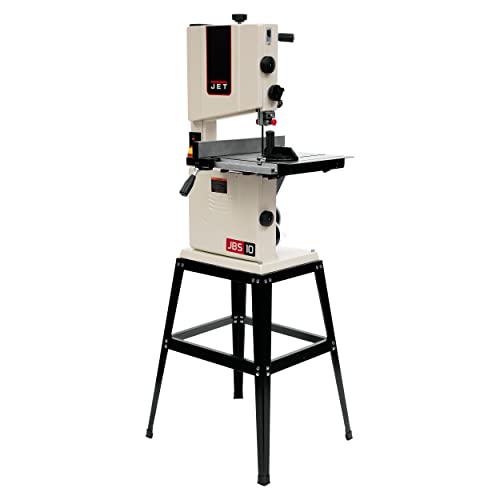
No exact JWBS-9 offer is retained. The JWB-10 below is a different current JET open-stand model, not an exact replacement or a source for JWBS-9 specifications.
Documented specifications for JET JWBS-9
| Model | Machine family | Cut height (in) | Throat (in) | Blade length (in) | Blade width range (in) | Offer |
|---|---|---|---|---|---|---|
| JET JWBS-9 | Compact woodworking | 3.5 | 9 | 59.5 | 0.125–0.375 | No exact offer matched |
- Table dimensions
- Not confirmed × Not confirmed in
- Machine weight
- 40.8 lb
- Blade speed
- 2500 FPM
Current US JWBS-9 JT1-3604 benchtop model. Manufacturer marketing rounds weight to 40 lb; technical net field 40.8 used. Assembled 19x14.125x29in; 2.8A with recommended 10A circuit and 2.5in dust port. Table dimensions are not published on the current page and remain unknown.
A small saw works best with deliberately small jobs
JET lists a nine-inch throat, 3-1/2 inches of resaw capacity and an assembled size of 19 by 14-1/8 by 29 inches. The same page describes an approximately forty-pound machine, with a more specific net-weight field of 40.8 pounds. This points toward manageable craft components and small woodworking blanks. It does not establish that the machine is easy to carry or that every piece fitting its opening is practical to control.
Think through a representative project from full blank to finished outline. If the first step involves a large panel, another tool may be needed to produce a blank that can be handled comfortably at this saw. A compact machine can serve that second-stage shaping role well even when it is not the tool you use to break down stock.
The half-inch in the blade length matters
The JWBS-9 product specification gives a blade length of 59-1/2 inches and a width range of 1/8 to 3/8 inch. Do not automatically order the 59-1/4-inch loop commonly advertised for other nine-inch machines. A quarter-inch difference in loop length should be resolved against the exact manual, not dismissed because a supplier groups several brands into one search result.
Maintain a separate record for each saw if your shop owns more than one compact model. Write the length, width, thickness, and tooth pattern on the storage sleeve. When a blade performs poorly, that record helps establish whether the issue is an unsuitable tooth pattern, a worn edge, or a setup change. It also prevents the wider blade from a different machine from being installed by habit.
Give the benchtop mount enough attention
A lightweight machine needs a secure mounting arrangement. Follow JET's instructions and use a bench that does not rock during feed. The published machine height is 29 inches and the table-height field is 12-1/4 inches, but the current product page does not publish table width and depth. Do not substitute another nine-inch model's table dimensions when sizing a bench or support fixture.
Include space behind the blade, around the wheel-cover doors and for the 2-1/2-inch dust connection. Avoid unstable layers merely to change the working height. If the saw must be stored after use, establish a safe lifting and repeatable remounting routine before assuming the 40.8-pound net weight makes it portable.
A single speed encourages a clear material brief
JET lists a 2,500 SFPM blade speed, 120-volt operation and 2.8-amp current, with a recommended 10-amp circuit. Those are useful woodworking specifications, not a general-purpose metal-cutting approval. Define the material and consult the exact operating instructions before considering any non-wood task. Selecting a finer-tooth blade cannot compensate for an unsuitable machine speed or material procedure.
For ordinary wood projects, choose the narrowest blade only when the curve requires it. Very narrow blades trade straight-line stiffness for maneuverability. When following a pattern, leave enough material for the intended sanding or shaping step rather than trying to force the blade through an unsuitable radius. A deliberate relief-cut plan may make the work easier to handle without twisting the blade.
Compare its limits with the next size up
The JWB-10 is a different open-stand machine: it uses a 67-1/2-inch loop, accepts up to a 1/2-inch blade, has a four-inch opening and calls for a four-inch, 300-CFM dust system. The JWBS-9 uses a 59-1/2-inch loop, accepts up to 3/8 inch, has a 3-1/2-inch opening and a 2-1/2-inch dust port. Choose the larger JET only when those differences and the included stand solve a real need.
Conversely, if you repeatedly buy blanks close to the height limit, leave yourself room to grow. Capacity planning should include a stable carrier or jig when the work requires one, since that support consumes opening height. Make the purchase around the largest routine job, not one unusual project that might be handled another way. A small dedicated curve saw can remain useful even after a larger resaw machine joins the shop.
Questions about JET JWBS-9: The Current 9-Inch Benchtop Model
Which blade length belongs to the current JWBS-9?
JET lists 59-1/2 inches for JT1-3604. Do not substitute the common 59-1/4-inch size without exact-model approval.
How wide a blade can it accept?
The manufacturer specifies a maximum width of 3/8 inch and a minimum of 1/8 inch.
Is the JWBS-9 a floor saw?
It is a benchtop woodworking model. A mounting bench or suitable approved support is part of the installation.