models
JET JWB-10: Compact Saw, Stand, and Blade Fit Guide
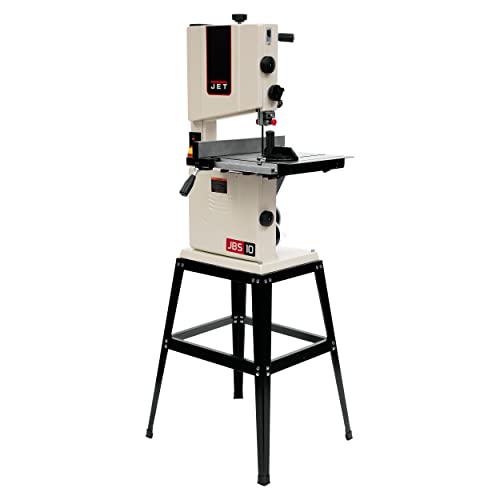
The current US JET JWB-10, stock number JT9-714000, is sold as a compact open-stand woodworking bandsaw. JET also labels its style as benchtop, but that field does not by itself approve removing the included stand or substituting a bench installation. The four-inch cutting height, 67-1/2-inch blade and documented 41-1/2-inch table height are the practical starting points. This guide does not transfer specifications from a JWBS-10, JWBS-10OS or overseas model.
As an Amazon Associate I earn from qualifying purchases. How affiliate links work.
Documented specifications for JET JWB-10
| Model | Machine family | Cut height (in) | Throat (in) | Blade length (in) | Blade width range (in) | Offer |
|---|---|---|---|---|---|---|
| JET JWB-10 | Compact woodworking | 4 | 9.5 | 67.5 | 0.125–0.5 | Check Amazon offer |
- Table dimensions
- 13.375 × 13.125 in
- Machine weight
- 83 lb
- Blade speed
- 2750 FPM
Current US JWB-10 JT9-714000 open-stand package; do not substitute JWBS-10OS/regional specifications or infer stand removal from the Benchtop style field. Table 13.125x13.375in unextended and 13.125x19in extended; 115V, 3.4A, recommended 20A circuit; 4in dust port and 300 CFM required collection; 83 lb net and 41.5in table height. Factory blade record is 67.5x0.375x0.014in, 6 TPI.
Get the identity right before buying a blade
JET's current US product page names this machine JWB-10 and specifies a 67-1/2-inch blade. Accepted widths run from 1/8 to 1/2 inch. The official parts record identifies the factory blade as 67-1/2 by 3/8 by .014 inch, 6 TPI; that included general-purpose blade is not proof that it suits every radius, stock thickness or finish goal. The loop is shorter than the blades used by several ten-inch RIKON saws, even though the wheel class is similar.
When buying used, photograph the identification label rather than relying on a seller's shortened title. Manuals, belts, guides, and switches can differ across machines with nearly identical names. Ask whether the original fence, table-extension parts, miter gauge, and stand fasteners remain with the saw. Missing accessories deserve an exact replacement-part search before you decide the package is complete.
The extension adds support, not throat depth
The manufacturer lists a 13-1/8 by 13-3/8-inch table, extending to 13-1/8 by 19 inches. The throat remains 9-1/2 inches and the cutting height is four inches. Extra table width can help support a broader workpiece near the cut, but it cannot move the frame out of the way or increase clearance beneath the guide.
For curved work, trace the entire intended motion with the saw disconnected and the blade safely avoided. A board that rests on the expanded table can still collide with the column when rotated. For straight work, use independent support when the board extends far beyond the table. The table extension should not become a reason to balance long stock precariously.
Think of the motor as part of a complete system
JET specifies a 1/2 HP, 115-volt motor, 3.4-amp current and a single 2,750 FPM blade speed. The product page recommends a 20-amp circuit. Those numbers belong in a woodworking comparison, not a claim that every material can be cut safely at that speed. The machine's operating manual and blade guidance should control material selection; broad marketing language is not a metal-cutting approval.
The published extraction requirement is a four-inch dust port with 300 CFM required collection. Treat that as a system requirement to plan, not a guarantee of measured capture in a particular shop. Confirm the circuit, plug, collector connection and simultaneous loads before deciding that an existing bench outlet and shop-vac hose complete the setup.
Set up for reach, light, and dust
The current package is documented as an open-stand machine. JET lists an assembled footprint of 30 by 19-1/2 inches, a 59-1/2-inch overall height, a 41-1/2-inch table height and an 83-pound net weight. Those figures help plan a dedicated station, but they are not floor-clearance or material-support dimensions. Allow room for the wheel doors, the extended table, the stock path and the four-inch dust hose.
Do not remove the supplied stand merely because one product-page field says benchtop. The current page and exact Amazon offer both describe an open-stand package, while the official dimensions describe the assembled machine. Any alternative installation needs exact-manual support or manufacturer clarification. Position the documented setup so the controls remain reachable and cords, hoses and supports stay outside the feed path.
The purchase case is compact versatility
Choose the JWB-10 over the JWBS-9 when the included stand, wider 1/2-inch blade limit, 9-1/2-inch throat or extending table solves a recurring need. Choose the JWBS-9 when a true benchtop installation, 40.8-pound net weight and 3-1/2-inch opening are enough. Consider the Laguna V:10 when a documented six-inch current-page opening, two speeds and optional rather than included stand are the better package; confirm its 5.75-versus-6-inch listing conflict first.
If a JWB-10 already belongs to your shop, start an accuracy investigation with a known suitable blade and a square reference board. Check the table against the blade body, not a tooth that protrudes through its set. Then inspect the guide setup and actual fence position. Record whether a fault appears only under load, since a satisfactory unloaded tracking check cannot explain every cutting problem.
Questions about JET JWB-10: Compact Saw, Stand, and Blade Fit Guide
Is JWB-10 the same name as JWBS-10?
This guide covers the current US JWB-10, JT9-714000. Confirm the label before applying its specifications to another similarly named machine.
What blade length does the JWB-10 require?
The current JET specification is 67-1/2 inches, with widths from 1/8 to 1/2 inch.
Does extending the table increase cutting width?
It increases work support. The throat between blade and frame remains 9-1/2 inches.
Can the JWB-10 stand be removed for bench mounting?
The current US product and exact offer describe an open-stand package. A separate style field says benchtop, but that is not installation approval; use the stand as documented unless the exact manual or JET authorizes another arrangement.