accessories
Bandsaw Miter Gauges: Measure the Slot First
The most sophisticated miter gauge is a poor upgrade if its bar does not fit your bandsaw table. Compact saws can use slots that differ from the common table-saw pattern. Begin by measuring slot width, depth, and profile, then evaluate the gauge’s overall size and available travel. Precise angle markings matter only after the accessory fits and moves without unwanted play or obstruction.
As an Amazon Associate I earn from qualifying purchases. How affiliate links work.
Record slot dimensions and profile
Measure the slot at several accessible points and compare the measurements with the accessory maker’s supported range. Note whether the slot has straight sides or a wider retaining channel underneath. A nominal dimension in a sales listing may hide a tolerance range that determines whether the bar actually slides.
INCRA publishes specific slot requirements for its gauges, including adjustment ranges. That level of information is useful because many benchtop owners otherwise assume that standard means universal. If your machine has an unusual slot, start with its original replacement gauge or an explicitly compatible accessory rather than planning to force a larger bar into place.
Look beyond width to bar depth and length
A bar that is too deep can hold the gauge above the table even when its width is correct. A retaining washer may also interfere with a slot that lacks the corresponding lower channel. Check the full bar assembly and the manufacturer’s instructions for any removable or adjustable component.
Length matters on a small table. A long bar may extend beyond the supported area early in the cut or collide with the saw body. Work through the intended travel with the machine disconnected and the accessory dimensions represented on the table. Confirm that the gauge remains supported where the workpiece reaches the blade and that the operator can maintain a comfortable position.
Match fence size to small work
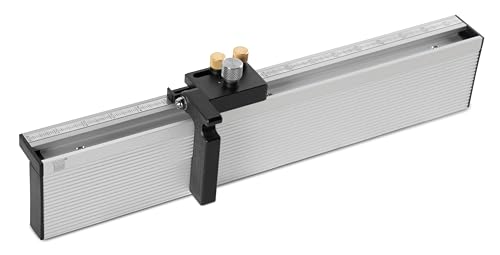
A large telescoping fence can be useful on a table saw but disproportionate on a benchtop bandsaw. Compare its total length, adjustment knobs, and end stops with the saw’s throat and the parts you cut. Extra capacity is valuable only when it remains usable within the machine’s envelope.
If you want an auxiliary wooden face, check how it attaches and where the fasteners will sit. Consider whether the face can be renewed after wear. A modest, well-supported face may be easier to use than a heavy extrusion designed for much larger equipment. The gauge should help hold a reference angle without encouraging work that exceeds the table’s support capacity.
Decide what angular features are worth paying for
Positive stops are convenient when you repeatedly return to common angles. Fine adjustment can help when a project calls for a specific setting. Neither feature removes the need to verify alignment against the blade and the actual work. A detailed scale is not evidence that the saw will produce the same accuracy as a different machine using that gauge.
For occasional square cuts, a simple compatible gauge may be enough. For repetitive angled parts, a better locking mechanism and useful stops may justify the upgrade. Write down the recurring angle and workpiece size before comparing premium features. This avoids paying for a large adjustment range that is irrelevant to the projects the bandsaw can handle.
Check what the purchase includes: gauge head, bar, fence, stop, and hardware are not always sold together. Ask whether the accessory can be returned if a documented fit check reveals an incompatibility. Keep the slot measurements and confirmed part number with the saw’s records so the next purchase begins with established dimensions rather than another search for a supposedly universal gauge.
If the original gauge has play, identify whether it comes from the bar-to-slot fit or the angle head before replacing the whole assembly. Those issues suggest different purchasing priorities. A premium head on a poorly fitting bar still leaves unwanted movement, while an accurate bar cannot compensate for a head that will not lock. Describe the location of the problem when asking the supplier to recommend a compatible replacement.
Questions about Bandsaw Miter Gauges: Measure the Slot First
Do all bandsaws use a three-quarter-inch slot?
No. Measure your table and compare its width, depth, and profile with the gauge’s explicit requirements.
Can an adjustable bar fit any slot?
No. Adjustment covers a specified range, usually a small one. It cannot compensate for a fundamentally different slot size.
Is a long table-saw fence useful here?
Only if it clears the saw and remains supported through the cut. A compact fence can be more practical on a small table.