accessories
Benchtop Bandsaw Fences: Check Fit Before Upgrading
A replacement fence is useful when it provides the support and adjustment your work needs without obstructing the saw. On a compact bandsaw, the first challenge is physical fit. A fence designed around a fourteen-inch machine may have a rail, bracket, or face that overwhelms a smaller table. Measure the mounting arrangement and operating envelope before comparing scales, knobs, or advertised precision.
As an Amazon Associate I earn from qualifying purchases. How affiliate links work.
Map the front of the table
Record table width, depth, edge thickness, mounting-hole positions, and the path used to remove the blade. Look below the table for the tilt mechanism and any controls. A front rail can fit the bolt pattern yet block an access point or prevent the blade from being removed conveniently.
Determine whether the original fence clamps only at the front or also uses the rear edge. A replacement relying on rear clamping needs the correct table depth and rear-edge geometry. Do not infer compatibility from a photograph of the fence on a different saw. Ask the manufacturer to confirm the exact model or provide a drawing showing the required mounting surfaces.
Treat full-size accessory claims carefully
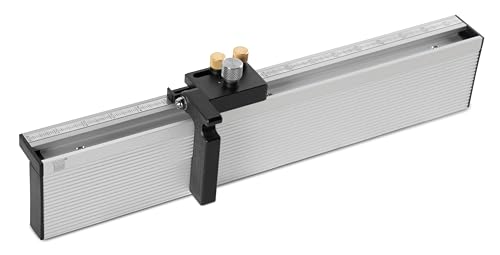
Kreg’s KMS7200 is marketed around fitting most fourteen-inch bandsaws, with provisions for adapting other machines. That is not an automatic fit claim for every small benchtop saw. Even where a rail can be adapted, the buyer should assess the complete installation and any manufacturer-approved modifications.
A large fence face may also reduce useful working space. Compare its length and height with the parts you cut, the upper guide assembly, and the table at the bevel angles you use. An accessory that suits resawing tall stock can be awkward for low-profile pieces if it prevents the guide from approaching the work as intended.
Buy adjustment you can actually use
A fence should lock consistently and provide a practical way to establish the intended alignment. A readable scale is convenient for repeat work, but it needs a reliable reference and calibration. It does not replace measuring the real cut or accounting for blade changes.
Consider whether you need a tall face, a low face, or an interchangeable auxiliary face. Thin work often benefits from access close to the table, while taller work may need broader support. If the fence accepts an auxiliary face, check the mounting method and whether fasteners can be kept clear of the blade path. Buy the configuration your work requires rather than the tallest available extrusion.
Compare a replacement with a modest support solution
If you only need occasional straight cuts, the existing fence may be adequate after the machine is correctly set up. An approved auxiliary face or a properly secured guide can sometimes meet a narrow requirement without a complete rail system. The important purchasing question is what the new fence will improve: repeatability, support height, usable travel, or locking convenience.
A fence cannot cure an unsuitable blade or a machine beyond its intended capacity. If cuts wander, identify the underlying cause before committing to a premium accessory. Otherwise the new fence may merely constrain the work more firmly while the original problem remains.
Before ordering, list the required hardware and any separate face, rail, mounting bracket, or measuring tape. Confirm whether table tilt and blade access remain usable, whether left-side and right-side travel meet your needs, and what adaptation does to return eligibility. Keep a dimensioned sketch with the order. That small amount of preparation is more valuable than buying a highly rated fence that never becomes comfortable on the saw.
Make a simple paper or cardboard outline of the proposed rail and fence face using the published dimensions. With the saw disconnected, place it beside the table and check door access, blade-removal space, and common work positions. The mock-up does not establish structural compatibility, but it can expose an obvious clearance problem before ordering. Send any uncertain mounting detail to the manufacturer rather than treating a successful outline check as installation approval.
Questions about Benchtop Bandsaw Fences: Check Fit Before Upgrading
Will a fourteen-inch bandsaw fence fit a nine-inch saw?
Possibly with a supported adaptation, but nominal saw size is not proof. Check table geometry, mounting, clearance, and operating access.
Is a taller fence always better?
No. It can support taller work but may obstruct the guide assembly or thin parts. Choose a face appropriate to your work.
Will a fence fix wandering cuts?
It supplies a reference and support. Blade selection, condition, and machine alignment remain separate issues.