brands
Eastwood Bandsaws: Benchtop Metal Saw or Floor Upgrade?
Eastwood’s benchtop band saw coverage belongs primarily to metal fabrication. Item 20237 is a compact metal-cutting saw with clamped stock, while the documented 21980 seven-by-twelve horizontal/vertical machine is a larger shop installation. Choosing between them requires thinking about stock preparation and support, not comparing either one directly with a small woodworking curve saw.
As an Amazon Associate I earn from qualifying purchases. How affiliate links work.
No Amazon listing was matched to this brand. The offers below are alternative brands to investigate, not products from the brand discussed.
Item 20237 is the compact metal-cutoff reference
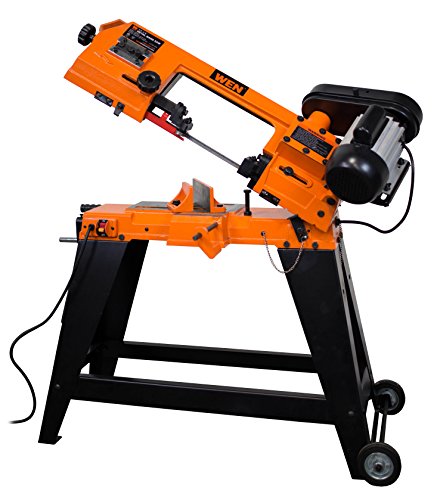
Eastwood’s manufacturer manual identifies item 20237 as the benchtop band saw and describes a 1000-watt 120-volt motor with variable blade speed from 100 to 260 feet per minute. Its clamp pivots for angular work. This is a vise-based cutting arrangement rather than a broad table on which the user steers a wooden pattern around a narrow blade.
My assessment is that this category is most relevant to a small fabrication area preparing tubing, bar or other suitable metal stock. Begin with a list of sections and angles you actually cut. If the intended work is shaped timber, select a woodworking saw category instead of treating the word benchtop as proof of interchangeability. The way the material is held and moved is as important as the motor rating.
Use the capacity chart instead of the largest headline number
The 20237 manual gives separate round and rectangular capacities at straight and 45-degree settings. For round stock, it lists 3.3 inches at 90 degrees and 2.7 inches at 45 degrees. The rectangular entries are 3.3 by 4.1 inches and 2.5 by 2.9 inches respectively. Keep those distinctions intact when comparing the saw with another machine.
If a planned miter barely fits a chart value, confirm the actual setup before committing material. The same stock can present a different section to the blade as the angle changes. Also consider whether sufficient length remains in the clamp near the end of a bar. A nominal capacity does not answer every question about short pieces, awkward profiles or unsupported stock.
Replacement blades are attached to the item number
Eastwood’s replacement-blade page identifies a blade for 20237 measuring 52 inches long and 1/2 inch wide, with 12–14 teeth per inch. That is a model-specific consumable reference. Do not replace it with the common blade length from a similarly sized wood saw, and do not assume another Eastwood machine takes the same blade.
Before buying a used example, locate the correct replacement blade and review its intended application. A seller’s collection of spare blades only helps if the dimensions and condition are right. Keep your blade record with the manual, including thickness and other requirements specified for the actual unit. Changing tooth configuration for a task is a separate decision from ensuring the blade physically fits.
The 21980 is a floor-machine alternative
Eastwood publishes a separate instruction manual for item 21980, titled 7-by-12-inch Horizontal/Vertical Metal-Cutting Band Saw. The document describes a 1-HP machine. Its larger format and alternative operating orientations belong in a shop-floor comparison; they should not be used to inflate the capability of compact 20237.
Vertical capability on a metal-cutting machine is not automatically the same workflow as a dedicated woodworking band saw. Check the manufacturer’s permitted setup, table arrangement and material instructions. If your routine is repeated stock cutoff, evaluate the horizontal workholding and feed arrangement first. If a vertical operation is essential, establish exactly how the stock is supported in that configuration before making it a deciding feature.
Allow room for stock and finished pieces
A compact machine can need a long operating corridor when the raw material arrives as bar or tubing. Plan supports on both sides where required, access to the clamp and a controlled place for the cut piece. Eastwood’s 20237 manual explicitly requires use of the clamp and warns against forcing the cut. The machine’s small base does not remove those operating needs.
Keep the cutting area separate from the bench space needed for measuring and assembly so stock preparation does not continually interrupt other work. Consider whether the saw will remain set up or be stored between sessions. Repeated lifting, reconnecting and repositioning can outweigh a small footprint advantage if the machine is used throughout the day.
Choose the smallest complete arrangement that suits the work
The 20237 is worth comparing with other compact vise-based metal saws when your material fits its angle-specific chart. The 21980 becomes a separate consideration when the larger category solves recurring capacity or workflow needs. Neither should be chosen simply because it belongs to a familiar fabrication brand.
This guide uses manufacturer documents and makes no hands-on accuracy, durability or speed-ranking claim. For an existing unit, diagnose blade condition, workholding and prescribed adjustments before deciding the entire saw is inadequate. For a prospective purchase, confirm exact item identity and completeness. A useful decision connects the machine’s verified configuration to the cuts you repeatedly need, with room to perform them properly.
Questions about Eastwood Bandsaws: Benchtop Metal Saw or Floor Upgrade?
Is Eastwood 20237 a wood-pattern benchtop saw?
It is a compact metal-cutting saw using clamped stock, not a conventional woodworking curve-saw layout.
Which replacement blade does Eastwood identify for 20237?
Its replacement page specifies a 52-inch-long, 1/2-inch-wide blade with 12–14 TPI. Confirm all requirements against the actual machine manual.
Does 20237 retain full capacity at 45 degrees?
No. Its manual gives separate, smaller capacities at 45 degrees for round and rectangular stock.