accessories
Bandsaw Guide Bearings: Replacement or Upgrade?
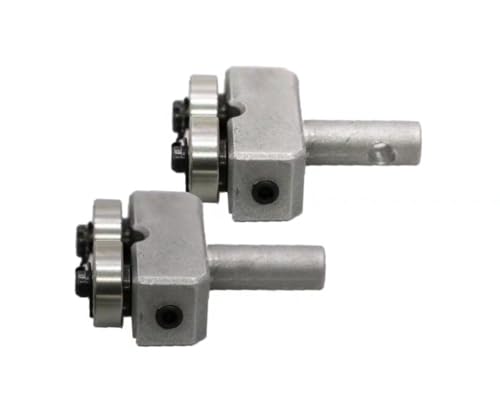
Buy guide bearings to solve an identified support or wear problem, not because a larger assembly looks more professional. On a benchtop saw, mounting dimensions and usable blade range can matter more than the accessory’s brand. First decide whether you need an individual replacement bearing, a complete original guide assembly, or an aftermarket conversion. Those are different purchases with different compatibility and cost questions.
As an Amazon Associate I earn from qualifying purchases. How affiliate links work.
Identify the part that actually needs replacing
A rough or damaged bearing is a different problem from a loose mounting bracket or a guide system that cannot accommodate your intended blade. Use the machine’s exploded parts diagram to identify the affected component. Ordering a bearing alone will not repair a damaged shaft, missing spacer, or cracked bracket.
Record the original part number and any dimensions the manufacturer supplies. Bearing bore, outside diameter, width, sealing arrangement, and mounting hardware can all be relevant. A matching outside diameter is not enough. If the part is unmarked, ask the saw maker for a replacement specification instead of relying on a photograph that resembles your guide.
Check a conversion kit against the whole saw
An aftermarket kit may replace several components and change the space around the blade. Confirm exact model compatibility, including revisions. Carter’s fitting resources are an example of a manufacturer offering help when a saw is not clearly listed. Send the requested measurements and images rather than treating a similarly sized machine as proof of fit.
Check both upper and lower assemblies. The lower guide lives near the table trunnion, dust port, and insert, so a kit that appears to fit the upper post can still create problems below. Ask whether the conversion preserves table tilt, access to adjustments, and the saw’s stated blade-width range. An upgrade that loses a function you use may be a poor trade.
Access and adjustment are purchasing features
On a small saw, the ability to reach and lock an adjustment can determine how pleasant the guide system is to use. Look at photographs with the table installed, not just isolated product images. Consider whether your fingers or the supplied wrench can reach the fasteners without repeatedly removing unrelated parts.
Tool-free knobs can be convenient, but they also occupy space. Compare them with your smallest blade, the guide-post position needed for thin work, and any fence you use. Ask for the installation instructions before ordering. Clear instructions and identifiable replacement parts are tangible ownership benefits; vague claims of improved accuracy are harder to evaluate.
Set a spending limit around the machine’s role
A premium conversion may make sense on a saw you intend to keep and use frequently. On a lightly used entry-level machine, an original replacement assembly and a suitable blade may be a more proportionate purchase. Compare the delivered kit cost with the value of the specific capability it adds, rather than with the entire cost of a new saw in isolation.
Do not expect guide bearings to correct every poor cut. Blade suitability, machine condition, and alignment remain separate issues. If you cannot describe what the new guide system changes, postpone the upgrade until the problem is identified. This is especially useful when a seller attributes all wandering cuts to the original guide design.
Before checkout, establish what is included: upper guide, lower guide, brackets, spacers, fasteners, and any blade-specific parts. Confirm availability of replacement bearings for the new kit. Keep both the conversion instructions and the original parts together so the machine’s configuration is understandable when it is serviced or eventually sold.
For an online fit inquiry, include views from the front, side, and beneath the table, with the machine disconnected. Show the mounting post and nearby obstructions rather than sending only a close-up of the bearing. Provide the blade widths you intend to use and the table angles that matter. This gives the kit supplier enough context to identify a practical fit instead of merely recognizing a familiar-looking component.
Questions about Bandsaw Guide Bearings: Replacement or Upgrade?
Can I use any bearing with the same outside diameter?
No. Bore, width, seals, mounting, and clearance must also match the original specification.
Will upgraded guides eliminate blade drift?
They may improve support or adjustment, but they do not guarantee correction of blade, alignment, or machine-condition problems.
Should I buy a kit for another brand’s similar saw?
Only with explicit fit confirmation from the kit supplier. Similar wheel size and appearance do not establish compatibility.