buying guides
Best Benchtop Bandsaw for a Small Shop
The best benchtop bandsaw for a small shop is the machine whose complete working station fits the room and the normal project. Compare the stored footprint, stock-travel envelope, service access, table height, blade supply and dust route together. A stand-equipped compact saw can sometimes preserve more useful bench space than a nominal benchtop model.
Plan this decision
Map the working zone
Use the saw's actual footprint and your chosen front, rear and side clearances; table size is not a substitute for base dimensions.
Filter by the cut envelope
Shortlist documented woodworking models by height and throat before deciding where a machine belongs.
Price the whole station
Enter current quotes for the machine, blades, support and extraction instead of relying on a stale package price.
As an Amazon Associate I earn from qualifying purchases. How affiliate links work.
Exact retained offers are available for WEN BA3959, WEN BA3962 and RIKON 10-3062S. Grizzly G0803Z remains source-only with no exact retained Amazon offer; no substitute is presented as that model.
Side-by-side buying comparison
| Model | Machine family | Cut height (in) | Throat (in) | Blade length (in) | Blade width range (in) | Offer |
|---|---|---|---|---|---|---|
| WEN BA3959 | Compact woodworking | 3.5 | 9 | 59.5 | 0.125–0.375 | Check Amazon offer |
| Grizzly G0803Z | Compact woodworking | 3.625 | 9 | 62 | 0.125–0.375 | No exact offer matched |
| WEN BA3962 | Compact woodworking | 6 | 9.75 | 72 | 0.125–0.5 | Check Amazon offer |
| RIKON 10-3062S | Compact woodworking | 5 | 9.625 | 70.5 | 0.125–0.5 | Check Amazon offer |
Check the model guides for regional variations and source qualifications. Table dimensions do not establish performance or material suitability.
Map the space the cut actually occupies
Put a cardboard outline of the proposed machine on the bench, then move an example workpiece through the cutting position. Include its approach, exit, and rotation around the blade. A curved chair component may need more surrounding room than its final size suggests. A long narrow strip needs support beyond the table even when it easily clears the frame.
Now repeat the exercise with the piece standing on edge for any planned resawing. This exposes obstructions from shelving, low ceilings, and neighboring equipment. A machine that fits on the bench may still fail this practical test. Keep the route to the switch clear and avoid arranging the work so you must twist around the frame to complete an otherwise straightforward cut.
Choose where the saw belongs permanently
A dedicated corner of a sturdy bench can be efficient for a light-duty 9-inch machine such as a WEN BA3959 or Grizzly G0803Z. It becomes less efficient if the same area is needed every day for assembly. Repeatedly lifting a saw into place adds handling, remounting, and reconnection to every session. Portable in a product category does not mean convenient to carry for every owner.
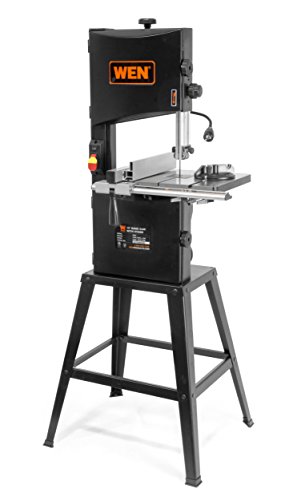
Stand-equipped candidates deserve comparison rather than automatic rejection. The WEN BA3962 and RIKON 10-3062S illustrate compact saws sold with supporting structures. A separate station can preserve the full depth of an existing bench. Compare the complete installed dimensions, and follow the manufacturer when deciding whether an alternative cabinet or mounting arrangement is appropriate.
Reserve room for servicing and extraction
Wheel doors need to open far enough to replace blades and clean the lower enclosure. Table adjustments and fence removal can also require clearance outside the advertised outline. The dust connection should have a natural hose route that does not create a tight bend or conflict with a drawer. A saw pushed hard against a wall may save a few inches while making every maintenance task inconvenient.
Storage should reflect what the station actually needs. Keep blades safely coiled and protected, with their length and tooth pattern identified. Give adjustment tools and push aids fixed places. Do not fill the immediate cutting area with accessories simply because a cabinet is nearby. Small-shop organization works best when frequently used items are reachable without entering the workpiece path.
Match mobility to the room’s real constraints
A movable cabinet can help a garage share space with a vehicle, but stability in use is essential. Use a suitable base or locking arrangement and respect the weight and mounting requirements of the equipment. Include the base in your working-height calculation. A station that rolls easily but places the table too high is an incomplete solution.
Before purchasing, rehearse the complete transition from stored to working condition. Consider doors, cords, hoses, lighting, and where offcuts will go. If the transition is cumbersome, the saw may see little use even when its cutting capacity is ideal. The strongest small-shop choice is often a machine that handles the normal project comfortably and can remain ready, with unusual large work handled elsewhere or by another appropriate tool.
Compare a bench station with a stand station
Draw two layouts at the same scale. The bench version needs the actual saw base, the bench area displaced, final table height, door swing, hose route and stock path. The stand version needs its complete footprint, the same stock path and enough access to service both sides. Count shared circulation space once rather than pretending every clearance rectangle remains permanently empty.
The compact BA3959 documents a 12-5/16 by 11-7/8-inch table, but that is not its base footprint or the room a cut needs. RIKON documents the stand-equipped 10-3062S at 21 inches wide by 16-1/4 inches deep overall and a table height of 39-7/8 inches. Those figures help compare station concepts; neither establishes that your bench, floor or mobile base is structurally suitable.
- Bench-first: useful when a suitable bench already exists, the final table height works and the saw can stay mounted without displacing essential assembly space.
- Stand-first: useful when a dedicated footprint preserves the main bench and the supplied configuration fits the stock path and service access.
- Mobile-first: useful only when the complete stored-to-working transition is manageable and the station is stable in operation.
- Different tool: preferable when normal work exceeds the compact envelope or forces makeshift support and repeated room rearrangement.
Choose the smallest station that clears the normal work
BA3959 and G0803Z belong in the compact nine-inch comparison when regular stock fits their roughly 3-1/2-inch opening class and nine-inch throat. They use different blade loops—59-1/2 and 62 inches—so storage and replacement supply must be planned by exact model. G0803Z remains source-only in the retained catalog rather than receiving a substitute offer.
BA3962 and 10-3062S are stand-equipped compact alternatives with documented six-inch and five-inch openings respectively. BA3962 uses a 72-inch blade; 10-3062S uses 70-1/2 inches. Choose the larger station only when its documented envelope or ownership features solve a named problem. Maximum opening remains clearance, not a promise of comfortable repeated resawing.
Questions about Best Benchtop Bandsaw for a Small Shop
Does a benchtop saw always save floor space?
No. It can occupy bench space that must be replaced elsewhere. Compare complete station layouts, including the workpiece path and maintenance access, against a compact stand-mounted alternative.
Can I put a bandsaw on a rolling cabinet?
Use a cabinet and mobility arrangement suitable for the saw, with secure mounting and stability during operation. Check the manual and calculate the resulting table height before building or buying it.
What should I measure before ordering?
Measure the machine area, door opening clearance, table and fence movement, dust hose route, and the space occupied by your longest and widest normal workpieces.