brands
Powermatic Bandsaws: Floor Saws Versus Benchtop Needs
A search for a Powermatic benchtop bandsaw needs a category check before a model recommendation. The manufacturer's documented range includes substantial floor woodworking machines such as the PWBS-14CS and PM1500. This research did not establish a current Powermatic benchtop model. That does not prove one has never existed, but it means a compact bench saw should not be invented from the brand name. The useful decision is whether your projects justify moving to a floor machine.
As an Amazon Associate I earn from qualifying purchases. How affiliate links work.
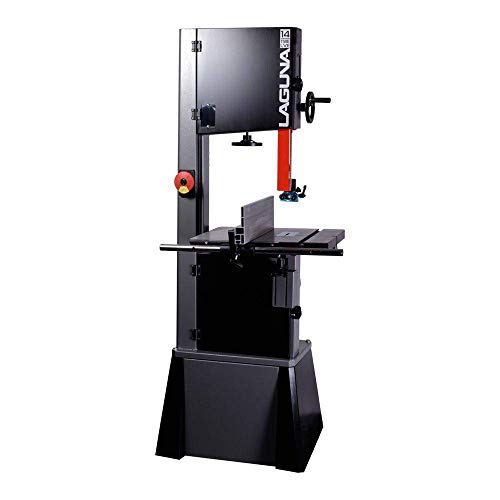
No Powermatic listing is retained. The Laguna 14|12 below is a different floor-class brand and model included only for category-level comparison.
The model list is more useful than the search label
Powermatic's current band-saw listing includes the fourteen-inch PWBS-14CS and fifteen-inch PM1500, as well as larger machines. The PWBS-14CS is listed as 1-1/2 HP with 115/230 V capability; the PM1500 listing specifies 3 HP and 230 V single-phase power. These are distinct product identities and electrical requirements, not interchangeable versions of a small benchtop saw.
When an advertisement simply says “Powermatic bandsaw,” request the full model number and nameplate before comparing it with a compact tool. Used machines can have different generations, electrical configurations, and accessory packages. A photograph showing only the upper frame hides the base and gives little evidence about installation requirements. Identify the complete machine first, then locate the manual for that model.
A floor machine solves a different space problem
A benchtop saw occupies a bench and may be stored between sessions. A floor saw creates a dedicated work station and requires a suitable delivery and movement plan. Neither arrangement is automatically better for a small shop. A permanent floor location may free valuable bench area, but the stock path can consume a substantial corridor whenever the saw is used.
Mark the planned machine envelope and working area on the floor. Include room for the operator, opening wheel covers, blade changes, extraction hoses, and the longest routine board. Check the route from unloading point through doorways and any steps. Being able to fit the machine in a corner says little about whether you can maneuver a large curved blank around its column.
Capacity and control should be tied to a recurring job
The main reason to consider a larger woodworking saw is a job that exceeds the smaller machine's comfortable working envelope. Broad-board resawing, larger furniture components, and bulky curved blanks can create that requirement. Motor output alone should not decide the purchase because the actual opening, blade range, support surface, and feed arrangement all constrain the result.
Write down the largest routine blank and the final dimensions you need from it. Include the workholding method and any allowance for flattening sawn faces. Then compare the exact candidate's documented capacities. This approach prevents a vague desire for a premium machine from becoming a purchase that is either unnecessarily large or still too limited in the dimension that matters.
Plan the power and blades as part of the machine
A230 V model requires an appropriate supply arrangement specified by its nameplate and manual. Do not infer that it can be used like a smaller 115 V saw merely because both are intended for woodworking. For a dual-voltage machine, changing configuration must follow the manufacturer procedure with qualified help where needed. A different plug by itself does not establish correct wiring.
Moving up in machine size usually means starting a different blade inventory. Existing compact-saw loops will not necessarily fit, and a large resaw blade does not replace a narrower blade for tight curves. Price the appropriate first blades and plan safe storage for them. Confirm how guides and tension are adjusted so that switching operations remains a realistic part of your workflow.
How to use Powermatic as an upgrade benchmark
Use the documented Powermatic models as floor-saw candidates when the project, installation, and support requirements justify that category. Compare them with other floor machines on actual capacities and operating features rather than treating the brand as a score. If your work consists mainly of small decorative outlines, a supported compact saw may remain the more practical fit even when a larger machine is appealing.
For a used Powermatic, inspect structural condition, guards, guide adjustment, tires, table support, and electrical identity before focusing on appearance. Identify missing parts from the exact diagram and ask about replacement availability. This guide makes no claim that a model is currently in stock locally, and it does not treat marketing language as measured proof of accuracy or production capability. The next step is an exact-model comparison, not a fictional benchtop recommendation.
Questions about Powermatic Bandsaws: Floor Saws Versus Benchtop Needs
Does this research identify a current Powermatic benchtop saw?
No. The documented candidates are floor woodworking models; the manufacturer range should be checked for future changes.
Which smaller Powermatic models should a benchtop owner investigate?
PWBS-14CS and PM1500 are relevant floor-saw reference points, with different electrical and installation requirements.
Should I choose Powermatic simply for more horsepower?
No. Confirm the opening, blade system, stock support, electrical configuration, and recurring project need before choosing a larger machine.